
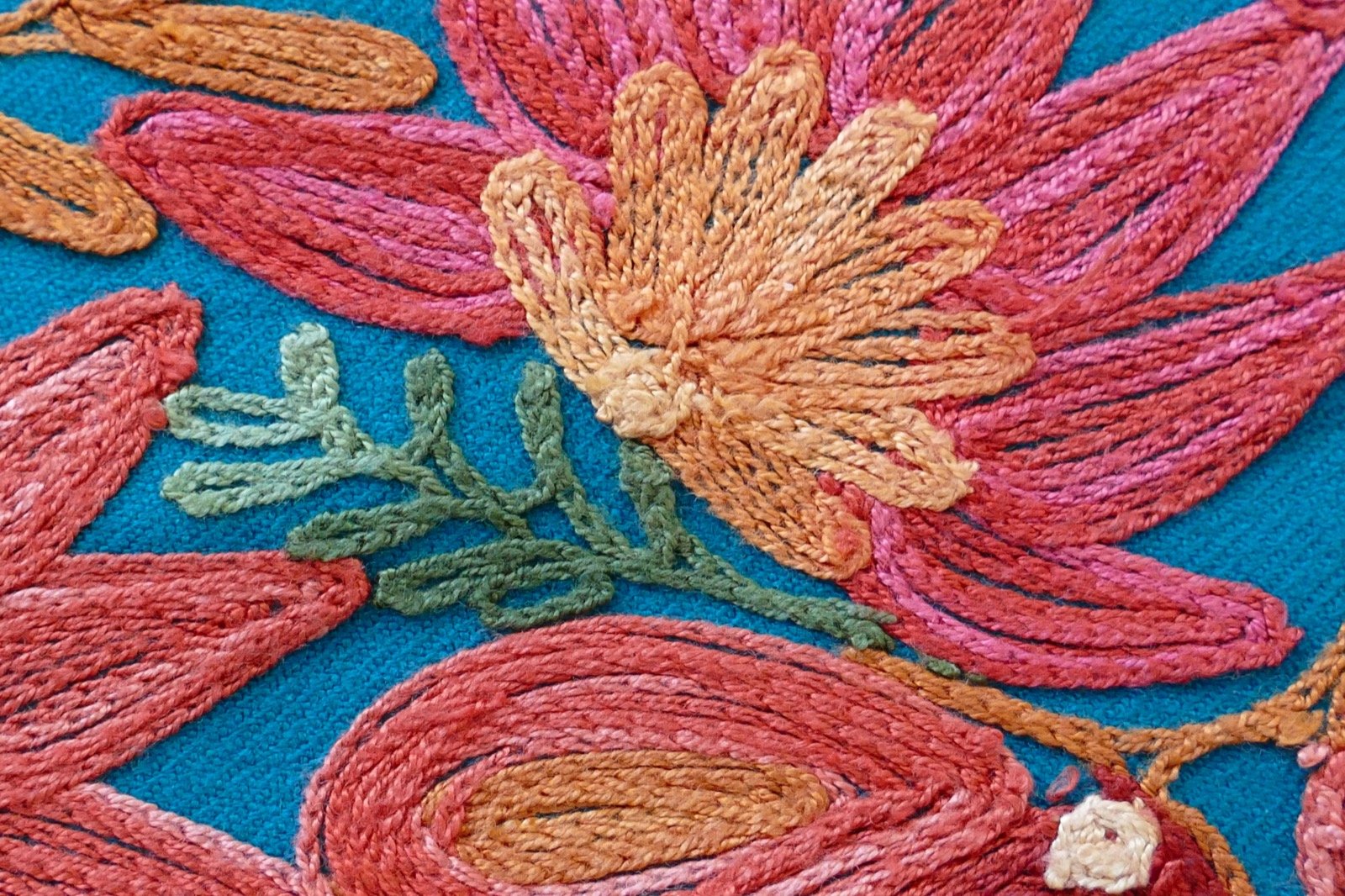
Sozni is Kashmir's finest needle embroidery - work so small the stitches are nearly invisible from the back. A full Sozni shawl takes three months to two years to complete. Here is how to tell the real thing from a machine print, why it matters, and where to buy from artisans directly.
In This Article
**Quick Answer:** Sozni is a Kashmiri embroidery technique done with a single fine needle on shawl fabric, with stitches so small they are nearly invisible from the back. Authentic Sozni work on a full Pashmina shawl takes between three months and two years depending on design density. It is a GI-tagged craft. Machine-printed or power-loom imitations are sold widely in tourist markets - there are clear physical differences between real and fake.
My mother has a Sozni shawl that came from her own mother's house. The design is a running vine of small leaves and flowers in two shades of blue on a cream Pashmina ground. She does not wear it often; it lives folded in tissue paper. When she does take it out, she always turns it over first, to show the back: the stitches visible on the reverse side, finer than sewing thread, laid in patterns that match the front almost perfectly. That is what she was taught to look for. Not the design - the back. Kashmir Pulse is Via Kashmir's editorial channel - written by locals, not agencies.
I think about that whenever I walk through the tourist market in Srinagar and see "Sozni shawls" stacked ten high on a shelf and priced at ₹800. Real Sozni cannot be priced at ₹800 for the same reason a hand-knotted carpet cannot be priced at ₹200 per square foot - the time has not been paid for. Something is on that shelf, but it is not what the label says.
What Is Kashmiri Sozni Embroidery?
Sozni is a form of needle embroidery distinct to Kashmir, practised for at least four centuries. The name derives from the Kashmiri word for needle. The defining characteristic is the fineness of the stitch - Sozni uses a very fine needle and a single thread to create motifs on a fabric ground, with stitches so small that the front face of the work appears as solid colour, not thread. The craft has been registered under India's Geographical Indication system - "Kashmiri Sozni Embroidery" is a protected designation, and only embroidery produced by artisans in the Kashmir region can legally carry that description. The fabric ground is usually Pashmina wool or a Pashmina blend. The embroidery itself uses silk thread - the lustre of silk against the matte wool ground is part of the visual signature of the work.

How to Tell Real Sozni from Machine Print: What to Look For
- Turn it over. On genuine hand-done Sozni, the reverse side shows actual stitching - loose threads, knots where sections end, the pattern readable from the back. On a machine print, the back is plain fabric or shows a bleed-through. There is no stitching to see.
- Feel the surface. Hand-embroidered Sozni has a slight raised texture where thread sits on fabric - running your finger across it, you feel the pattern. Printed versions are flat.
- Examine stitch lines under light. Angle the piece toward natural light. On real Sozni, you see individual stitch lines - tiny parallel marks like hatching. On print, the colour is uniform with no texture.
- Consider the time and price. A small stole with moderate design density takes four weeks to three months. A full-shawl with dense allover Sozni takes a year or more. Genuine full-shawl Sozni priced below ₹8,000-10,000 is almost certainly not real Sozni, not on real Pashmina, or both.
Sozni vs Other Kashmiri Embroidery Styles: What Is the Difference?
**Sozni vs Aari vs Tilla** | | Sozni | Aari (Chain Stitch) | Tilla | |---|---|---|---| | Needle type | Fine sewing needle | Hooked Aari needle | Fine needle | | Thread | Silk | Silk or wool | Zari (metallic) | | Effect | Delicate, almost painted | Bolder, more textured | Heavy, formal | | Typical base | Pashmina, silk | Wool, felt | Silk, velvet | | Common on | Shawls, stoles | Shawls, kurtas | Bridal wear | Sozni is the most delicate of the three. Aari is the most common in mass-market Kashmir craft. Tilla is the most labour-intensive and almost always formal wear.
Where to Buy Genuine Sozni in Srinagar
The tourist market on Boulevard Road is full of embroidery shops, most of which stock a mix of genuine and machine-made pieces without distinction. A few principles for buying well: look for GI-tagged pieces; go to the source directly where possible - Sozni artisans work in craft clusters around Rainawari, Bohri Kadal, and parts of Old Srinagar; allow time for the purchase - real Sozni shopping takes at least an hour; and set a realistic budget.
For a genuine Sozni stole on real Pashmina, expect to pay ₹5,000 - ₹15,000 depending on design complexity. A full-shawl with dense allover Sozni runs ₹25,000 upward. The J&K Government Arts Emporium on Boulevard Road stocks GI-tagged pieces at fixed prices. For travellers who want a verified local artisan connection, Via Kashmir can arrange craft visits as part of a Srinagar itinerary - [enquire here](https://viakashmir.in/enquire/general). That experience is closer to the real thing than any tourist-market shop.
Why Buying Real Sozni Matters
The J&K Handicrafts Department's 2023 craft census counted approximately 12,000 active Sozni artisans in Kashmir - down from an estimated 30,000+ in the 1980s. The decline is primarily economic: machine-printed shawls sold as "Sozni" at low prices undercut the handwork market, making it impossible for artisans to price their work sustainably. Buying genuine Sozni - verifying the back, paying a real price, going to an artisan rather than a tourist aggregator - is the act that keeps the craft economically viable.
Frequently Asked Questions: Kashmiri Sozni Embroidery
What makes Sozni different from other Indian embroidery traditions?
Sozni's defining characteristic is the fineness of the stitch - it uses a single fine needle and silk thread to create motifs so small that the work appears almost painted from the front. This distinguishes it from Lucknawi Chikankari (multiple stitch types on cotton) or Phulkari (geometric bold silk on cotton). Sozni is always on Pashmina or silk and is exclusively a Kashmir craft tradition.
Is Sozni embroidery GI-tagged?
Yes. Kashmiri Sozni Embroidery has been registered under India's Geographical Indication of Goods Act - only embroidery produced by artisans in the Kashmir region can legally be marketed with that designation. The GI registration was part of a broader effort to protect Kashmir's handicraft base, which also includes Pashmina wool and hand-knotted carpets.
How long does it take to make a Sozni shawl?
A stole with a simple border design might take four to six weeks for a skilled artisan. A shawl with an allover Sozni design - where embroidery covers most of the fabric surface - takes six months to two years. Master-level work in multiple colours on full Pashmina can take longer. This time investment is why authentic Sozni has a real price floor well above what tourist market vendors typically charge.
Where is the best place to buy Sozni in Srinagar?
The most reliable approach is to buy directly from artisan communities in Old Srinagar (Rainawari, Bohri Kadal). Government emporiums (J&K Government Arts Emporium on Boulevard Road) stock GI-tagged pieces with fixed pricing. For travellers who want a verified local connection, Via Kashmir can arrange artisan introductions as part of a Srinagar itinerary. Avoid buying from street sellers or rush-purchase shops in high-footfall tourist zones.
Can I commission a custom Sozni piece?
Yes. Artisan families accept commissions - you choose the base fabric, motif pattern, thread colours, and coverage density. Lead time is typically three to eighteen months depending on the piece. Price is agreed upfront based on design complexity. Working through an intermediary who knows the artisan community is recommended; Via Kashmir can help establish that connection at [viakashmir.in/enquire/general](https://viakashmir.in/enquire/general).
Planning a trip to Kashmir? Via Kashmir offers custom itineraries, verified hotels, and local cab services - planned by people who live here.
Plan Your Kashmir Trip →Kashmir Pulse Editorial
Culture Writer
Writing about Kashmir from the inside - hotels, culture, seasonal travel, and the stories that don't make it into guidebooks.
Ready to Experience Kashmir?
Let our local experts craft a personalised trip for you - hotels, houseboats, cabs, and experiences handpicked for your travel style.