
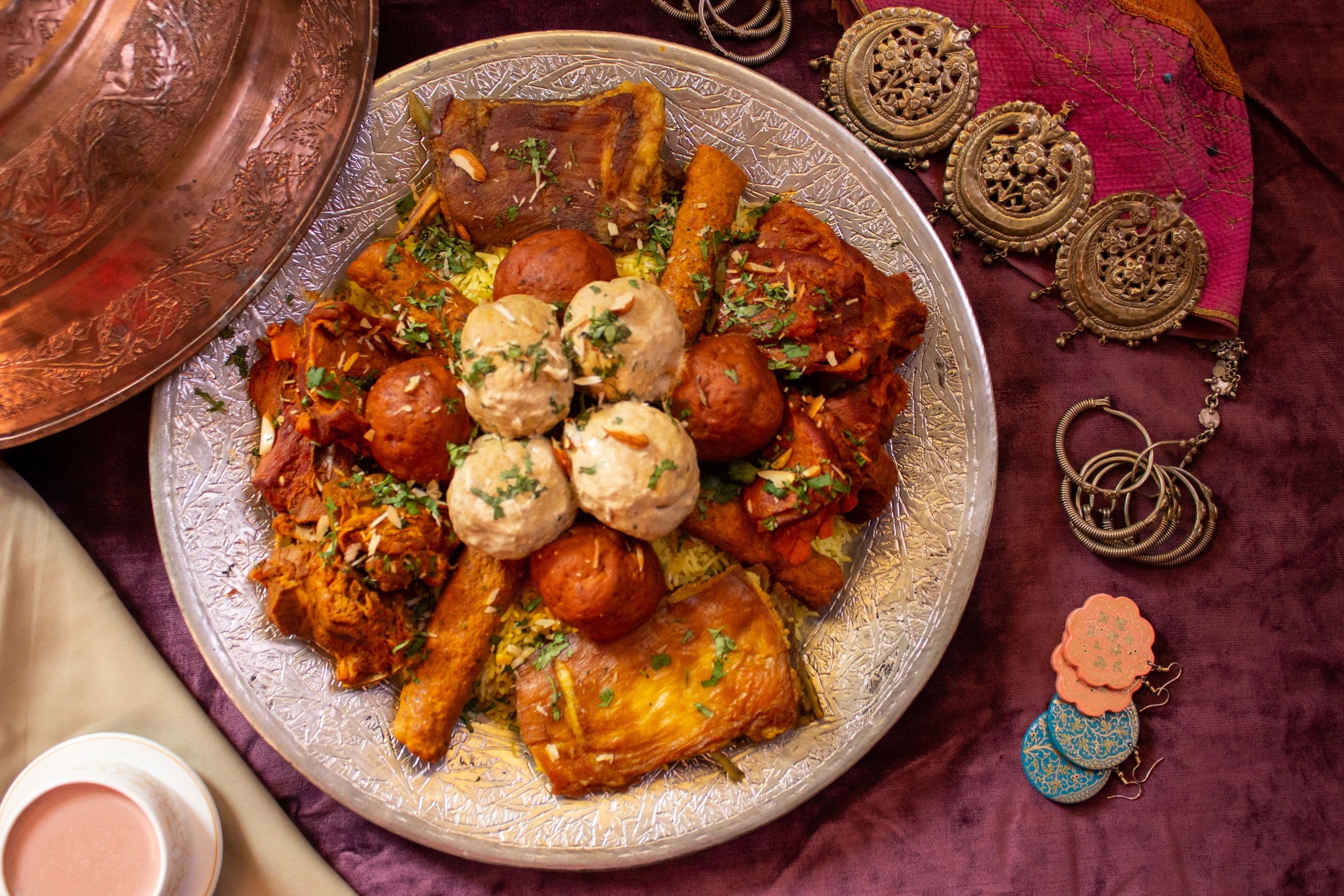
Wazwan is Kashmir's multi-course ceremonial feast - up to 36 dishes cooked overnight by hereditary chefs called Wazas, served on a communal copper traami shared between four. It is built entirely around mutton: Rogan Josh, Rista, Tabak Maaz, and the Gushtaba that ends every feast. Here is what you need to understand before you sit down for one.
In This Article
**Quick Answer:** Wazwan is Kashmir's multi-course ceremonial feast, traditionally served at weddings. A full Wazwan has up to 36 dishes cooked overnight by specialist hereditary chefs called Wazas. The essential dishes are Rogan Josh, Rista, Tabak Maaz, Seekh Kebab, and Gushtaba - all built around mutton. Via Kashmir can arrange a curated Wazwan experience for visitors on request.
The first time I sat for a full Wazwan, I was seven years old at my cousin's wedding in Sopore. I remember the copper traami being set down between four of us - a mountain of rice at the centre, and arranged around it, bowls of meat in sauces of different depths and colours. My grandmother leaned over and pointed to each dish in order. "Start from the outside. Work inward. Save room for the Gushtaba - that is how you end a Wazwan."
What Does the Word Wazwan Mean?
The word breaks into two parts: waz (cook or cooking) and wan (shop or establishment). Together it refers both to the feast itself and to the culinary tradition - a cuisine, not just a menu. The Wazas who prepare it are hereditary professionals; their knowledge passes from father to son across generations. A senior Waza oversees the cooking of a full wedding feast for 500 to 1,000 guests, managing a kitchen that runs through the night before the event.
The tradition is believed to have developed during the Sultanate period in Kashmir - roughly the 14th to 16th century - with strong Central Asian and Persian influences carried by merchants and rulers through the valley. The use of aromatic spices: fennel, dry ginger, black cardamom, asafoetida - rather than chilli heat - is the most distinctive marker of how Kashmiri cooking differs from the rest of the subcontinent.
A full Wazwan is said to have 36 courses, though most wedding spreads serve 12 to 15 dishes. The number 36 is as much symbolic as literal - it represents abundance and the completeness of hospitality.
- ✓Seekh Kebab - minced mutton on charcoal-grilled skewers, served first
- ✓Tabak Maaz - lamb ribs slow-cooked in milk and spices, then fried until crisp. The fat is intentional.
- ✓Shami Kebab - ground mutton patties with whole spices
- ✓Rogan Josh - mutton in Kashmiri red chilli and Ratan Jot sauce. No tomatoes. No cream.
- ✓Rista - pounded mutton meatballs in red gravy; texture should be almost silky
- ✓Methi Maaz - mutton with fresh fenugreek leaves
- ✓Aab Gosht - lamb in milk-based white gravy, cardamom and fennel
- ✓Gushtaba - the finale: pounded mutton-fat meatballs in yoghurt gravy. Always the last dish.
A Wazwan is only as good as its Gushtaba.
How Is Wazwan Served? The Traami Tradition
Wazwan is served on a traami - a large round copper platter, traditionally shared between four guests. Rice is mounded at the centre; the dishes are arranged around it and replenished throughout the meal. Eating together from one traami is deliberate - a statement about shared occasion and community. No cutlery at a traditional Wazwan. You eat with your right hand. This is not incidental to the experience; it is part of it.
Is Wazwan Different from Everyday Kashmiri Food?
Wazwan is often used as shorthand for "Kashmiri food" by visitors, but that conflates two different things. Everyday Kashmiri home cooking - rice with dum aloo, haak (collard greens), and mutton yakhni - is a quieter, simpler register. Equally worth seeking out. Wazwan is the ceremonial extreme of Kashmiri cooking, prepared by specialists for occasions of maximum hospitality.
- ✓Wazwan: professional Waza chefs, weddings, exclusively mutton, communal traami
- ✓Home cooking: family cooks, daily meals, mutton and vegetarian, individual plates
- ✓Restaurant dishes: individual Wazwan courses served à la carte - good, but not the full ceremony
Can Visitors Experience a Real Wazwan?
Yes - though not by walking into a random restaurant. A full ceremonial Wazwan is a private, invited affair. For visitors, the most reliable route is a curated Wazwan dining experience arranged through a local operator. Via Kashmir can arrange this on request through their local network - expect to pay ₹1,500–₹3,000 per person for a full spread, with a minimum group of 8–10. Give at least 48 hours' notice, as cooking begins the previous evening.
Frequently Asked Questions: Wazwan Kashmir
**Is Wazwan only mutton?** Traditionally, yes. Wazwan is built entirely around mutton - no chicken, no fish, no vegetarian alternatives. Some modern weddings now include a chicken option, but a traditional Waza will tell you this is a concession, not Wazwan.
**How many people is a Wazwan cooked for?** A traditional Wazwan serves 300 to 1,500 people at a wedding. Arranged experiences for visitor groups are done for 8–20 people, with the same dish sequence maintained.
**Can vegetarians eat Wazwan?** There is no vegetarian Wazwan. Kashmiri pandit cuisine has its own rich vegetarian tradition (dum aloo, nadru yakhni), but Wazwan is specifically a Kashmiri Muslim feast centred on mutton.
**What time is Wazwan served at weddings?** Lunch Wazwan is served noon to 2 PM. Dinner Wazwan runs from 8 PM onwards. Cooking begins the previous night - a full Wazwan is the result of 10 to 12 hours of continuous kitchen work.
**Is Rogan Josh in restaurants the same as in a Wazwan?** Authentic Kashmiri Rogan Josh uses Kashmiri red chilli, Ratan Jot plant bark, and no tomatoes. The versions served internationally bear the name but use a different technique. If you have only eaten the exported version, the original in Kashmir will feel like hearing a familiar song played as it was actually written.
Want to arrange a Wazwan experience or plan your Kashmir itinerary?
Talk to a Local →Kashmir Pulse Editorial
Travel Writer
Writing about Kashmir from the inside — hotels, culture, seasonal travel, and the stories that don't make it into guidebooks.
Ready to Experience Kashmir?
Let our local experts craft a personalised trip for you — hotels, houseboats, cabs, and experiences handpicked for your travel style.